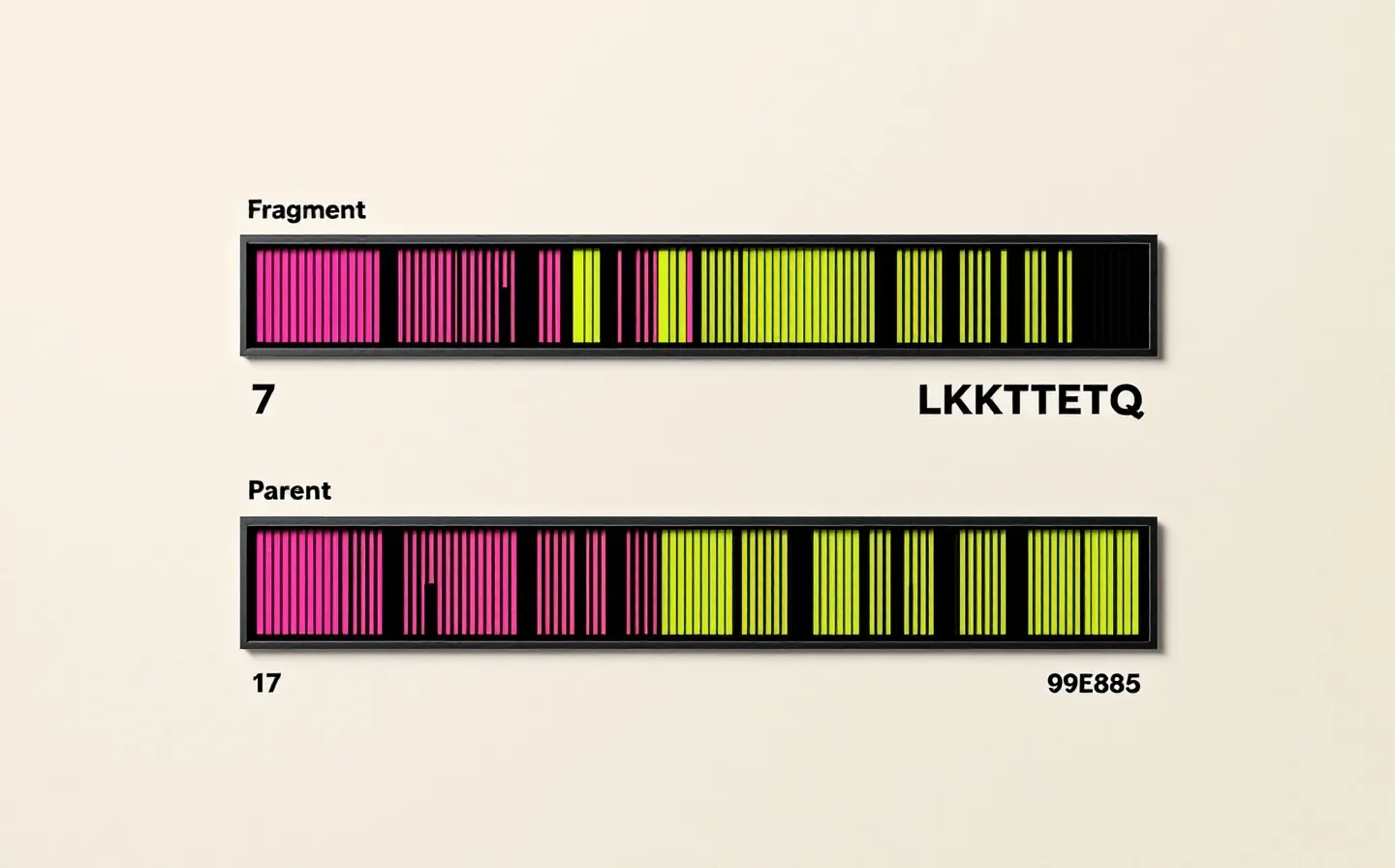
TB-500 is a seven-amino-acid fragment. Almost everything you have read about it is data on the 43-amino-acid parent.
An editorial framing of the Thymosin Beta-4 literature, structured so the fragment-versus-parent distinction is visible on every page.

The short version
TB-500 is a seven-amino-acid research peptide — the actin-binding core of a much larger protein called Thymosin Beta-4. The important thing most vendor pages skip: almost every encouraging study you will find was run on the full 43-amino-acid parent protein, not on this short fragment. The animal research for wound healing, cardiac protection and tissue repair is real. Whether the fragment reproduces those effects in people is a genuinely open question — there are no completed controlled human trials of TB-500 itself. TB-500 is also prohibited in competitive sport under WADA and is not FDA-approved for any use. This site is a structured reading of the literature, built to keep the fragment-versus-parent distinction visible on every page. Start with the effects page for what research-use communities report, then work through the research record and citation table.
What TB-500 actually is
TB-500 is a synthetic peptide with the sequence Ac-Leu-Lys-Lys-Thr-Glu-Thr-Gln-OH. It is seven amino acids long, weighs roughly 889 daltons, and carries CAS number 885340-08-9. The sequence corresponds to residues 17 through 23 of human Thymosin Beta-4 (Tβ4), a 43-amino-acid intracellular peptide encoded by the TMSB4X gene and expressed in nearly every nucleated cell type [1].
The central LKKTET motif inside TB-500 is the actin-binding core of the parent Tβ4 protein. The N-terminal acetyl group is a stability modification — it blocks aminopeptidase cleavage and slows degradation in solution. Beyond that, TB-500 carries none of the parent peptide's C-terminal sequence, none of its other interaction surfaces, and is missing the AcSDKP tetrapeptide that endogenous Tβ4 proteolysis liberates as a separately bioactive fragment [22].
In other words: TB-500 is a research analog of Thymosin Beta-4, sharing only the actin-binding domain.
The disambiguation this site is built around
Vendor pages and forum threads routinely refer to TB-500 and Thymosin Beta-4 interchangeably. The research record does not.
Every published animal study cited on this site used full-length recombinant or synthetic 43-amino-acid Tβ4. Every registered human clinical trial — RGN-259 ophthalmic solution in dry eye and neurotrophic keratopathy [15][16], RGN-352 intravenous Tβ4 in post-myocardial infarction [22], the US Phase I dose-escalation by Ruff and colleagues [13], and the Chinese Phase I by Wang and colleagues [14] — used full-length Tβ4. The 7-amino-acid fragment marketed as TB-500 has never been the subject of a registered human trial or a published human pharmacokinetic study [12][22].
The scientific transfer from parent to fragment is plausible. Two papers have shown that constructs containing the actin-binding domain retain dermal and corneal healing activity in mice [5][20]. But the published large-mammal and human data sit with the parent peptide, and the gap is the editorial point of this publication.
What the literature actually shows
The strongest preclinical signal for Tβ4 is in tissue repair, in three lanes:
Dermal and corneal wound healing. Topical Tβ4 at 5 micrograms accelerated reepithelialization of 8 mm full-thickness rat wounds by 42% at day 4 and 61% at day 7 [3]. The same molecule at 5 micrograms twice daily accelerated corneal healing and lowered IL-1β and chemokine mRNA after alkali burn in mice [4]. This preclinical foundation underwrites the entire RGN-259 ophthalmic program.
Cardiac repair. Tβ4 binds PINCH and integrin-linked kinase (ILK) to activate Akt, improving cardiomyocyte survival after coronary ligation in mice [6]. It also mobilizes adult epicardial progenitor cells, restoring multipotency and driving new coronary vessels in the injured adult heart [7]. A porcine ischemia-reperfusion study did, however, fail to show global infarct-size reduction with systemic dosing [21] — a negative result that has shaped how the cardiac program reads in 2025.
Stem-cell mobilization and angiogenesis. Tβ4 induces VEGF in endothelial cells, recruits skeletal-muscle satellite cells [10], increases hair-follicle keratinocyte migration [9], and, most recently, has been packaged into adipose-stem-cell exosomes inside dual-photopolymerizable hydrogels for diabetic wound closure (2025) [18].
What the literature does not show
There is no published human pharmacokinetic study of the synthetic 7-amino-acid TB-500 heptapeptide. Half-life figures of two to three hours that circulate online originate from vendor pages, not primary literature [12].
The Phase III ARISE-3 trial of 0.1% RGN-259 ophthalmic solution in approximately 700 dry-eye patients missed its prespecified co-primary endpoints, with positive secondary signals in ocular grittiness and two-week corneal staining [15]. A separate Phase III neurotrophic keratopathy trial showed 60% versus 12.5% complete corneal healing at day 29 (p=0.066, a narrow miss) and statistically significant healing at day 43 [16] — meaningful but not yet a regulator-grade efficacy result.
Tβ4 biology is also context-dependent. Conditional deletion of Tβ4 in hepatic stellate cells reduced liver fibrosis in a mouse CCl4 model [19], indicating that systemic Tβ4 is not biologically neutral across organs.
Finally: TB-500 is prohibited at all times under the World Anti-Doping Code, listed under section S2 (Peptide Hormones, Growth Factors, Related Substances and Mimetics) and the catch-all S0 (Non-Approved Substances). Equine doping-control labs have validated LC-MS detection in plasma and urine [20].
How to read the rest of this site
Each page below is structured as a sequence of framed blocks. Color-coded fills carry editorial categories: pink for mechanism, sky blue for clinical trials, lime for safety and preclinical animal data, gold for regulatory and WADA notes. The framing is the disclosure — every claim sits in a labeled box, every citation is a tile.
Start with the research record for the mechanism and the trial detail. Move to dosage for the research-context dose information and a frank note on the gap between published rodent dosing and the multi-milligram per-week schedules vendor literature promotes for the fragment. Use the FAQ for the questions readers most commonly bring to this molecule, and the references for the sortable citation table.