Questions readers bring to TB-500. Answered with citations, not vibes.
Each answer cites a named study from the references table. The fragment-versus-parent distinction is called out where it matters.
What is TB-500 and how is it different from Thymosin Beta-4?
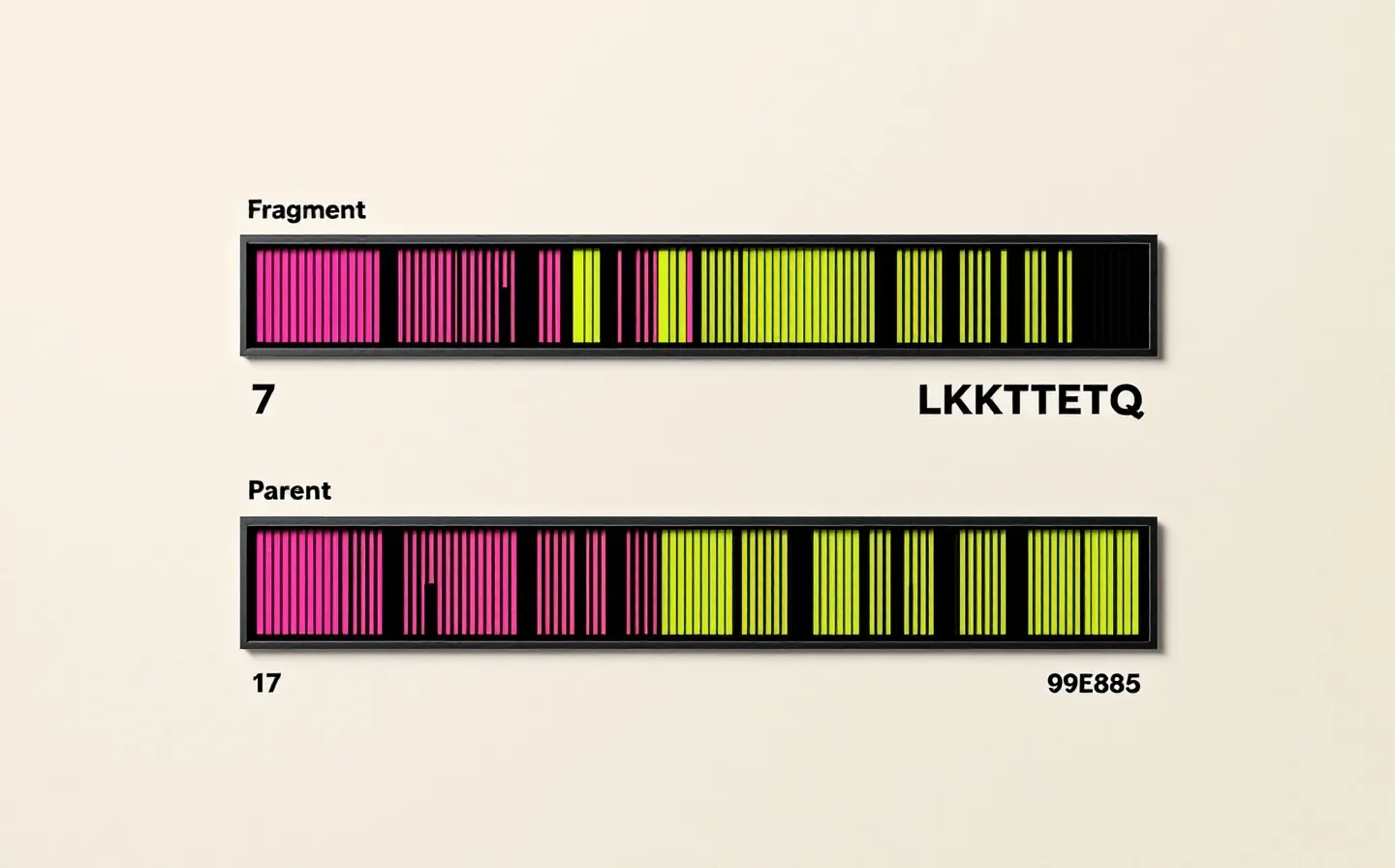
TB-500 is a synthetic seven-amino-acid peptide with the sequence Ac-Leu-Lys-Lys-Thr-Glu-Thr-Gln-OH — that is, residues 17 through 23 of human Thymosin Beta-4 (Tβ4), N-terminally acetylated for stability. Thymosin Beta-4 itself is a 43-amino-acid intracellular peptide encoded by the TMSB4X gene and present in almost every nucleated cell type [1].
The 7-AA TB-500 fragment retains the central LKKTET actin-binding motif of the parent peptide but lacks the C-terminal α-helix that crystallography identified as the major determinant of actin sequestration [2], and lacks the N-terminus from which the parent's AcSDKP fragment is cleaved [22]. Essentially every published animal study and every registered human clinical trial of 'Thymosin Beta-4' has used the full 43-AA parent peptide, not the 7-AA fragment [22]. The two terms are routinely conflated in vendor and forum material; the research record does not support that conflation.
How does TB-500 work at the molecular level?
The proposed mechanism — extrapolated from full-length Tβ4 studies — is built around three actions.
First, actin sequestration: the LKKTET motif binds monomeric G-actin in a 1:1 complex, blocking the actin monomer from joining growing F-actin filaments and maintaining a cellular reservoir of unpolymerized actin for rapid cytoskeletal remodeling [1][2].
Second, signaling: parent Tβ4 binds the PINCH adapter and integrin-linked kinase (ILK) to activate Akt, the cell-survival kinase implicated in cardiomyocyte protection [6]. It also directly binds NF-κB RelA/p65 to block TNF-α-driven inflammatory cytokine transcription [11].
Third, progenitor mobilization: parent Tβ4 reactivates adult epicardial progenitor cells in the heart [7] and chemoattracts skeletal muscle satellite cells [10].
How much of this transfers to the 7-AA fragment is genuinely uncertain — the actin-binding motif is preserved, the signaling and progenitor-mobilization surfaces are mostly missing.
What does the research say about TB-500 and tissue repair?
The strongest preclinical signal for any Tβ4-class molecule is in cutaneous and corneal wound healing in rodents. Topical 5-microgram dosing accelerated reepithelialization of full-thickness rat punch wounds by 42% at day 4 and 61% at day 7 [3]. The same molecule at the same microgram dose, twice daily topical, accelerated corneal healing and lowered IL-1β and chemokine mRNA after alkali burn in mice [4]. Philp and colleagues then showed both the full peptide and a synthetic peptide containing the actin-binding domain accelerated dermal wound repair in diabetic and aged mice [5].
This last paper is the closest the published literature comes to validating fragment-level wound-healing efficacy. The corneal data anchors the RGN-259 ophthalmic clinical program, which has reached Phase III in two indications [15][16].
What are typical research doses of TB-500 in animal studies?
Animal studies of Tβ4 cluster around four dose schedules. Topical at 5 micrograms per wound, with or without twice-daily repetition [3][4]. Intraperitoneal at 150 micrograms every three days in adult mice for epicardial mobilization [7]. Intravenous at 3.75 mg per kilogram, single dose, in rats 24 hours after embolic stroke [12]. Intracoronary retroperfusion at the end of ischemia in pigs (route mattered more than dose in this work) [8].
None of these are doses of the 7-AA TB-500 fragment — they are doses of full-length 43-AA Thymosin Beta-4. There is no published rodent dose-finding study for the synthetic heptapeptide [22].
Is there any human clinical trial data on TB-500 or Thymosin Beta-4?
Yes — but only for the full-length parent peptide.
Two Phase I safety trials have been published. Ruff and colleagues (US, n=40) tested single IV doses of 42 to 1,260 mg, with no dose-limiting toxicities or serious adverse events [13]. Wang and colleagues (China, n=84) tested single IV doses of 0.05 to 25 micrograms per kilogram and multiple doses of 0.5 to 5 micrograms per kilogram daily for ten days, with dose-linear PK and no SAEs [14].
In ophthalmology, the RGN-259 program has reached Phase III in dry eye (ARISE-1/2/3, missed co-primary endpoints with positive secondary signals) [15] and neurotrophic keratopathy (60% versus 12.5% complete healing at day 29; p=0.066) [16]. SEER-3 in European neurotrophic keratitis missed its primary endpoint [22].
In cardiology, RGN-352 (IV Tβ4) reached Phase II in approximately 75 post-MI patients [22].
No human trial has ever been registered or published for the synthetic 7-AA TB-500 fragment.
What is the half-life of TB-500?
The honest answer: nobody has published a peer-reviewed human pharmacokinetic study of the 7-AA TB-500 heptapeptide. The 'two- to three-hour plasma half-life' figures that circulate online for the fragment trace back to vendor pages and aggregator sites, not primary literature [22].
For full-length recombinant Tβ4, the published human IV pharmacokinetics — established in the Ruff (2010) and Wang (2021) Phase I trials — show biphasic plasma concentration decline with rapid distribution and terminal exposure measured over hours, without dose-dependent accumulation across the tested dose range [13][14]. The N-terminal acetylation in TB-500 plausibly extends solution stability versus the unmodified heptapeptide, but how this translates to in vivo half-life has not been measured in humans [22].
Is TB-500 banned by WADA?
Yes. TB-500 and Tβ4-class molecules are prohibited at all times under the World Anti-Doping Code, listed under section S2 (Peptide Hormones, Growth Factors, Related Substances and Mimetics) and the catch-all S0 (Non-Approved Substances) of the WADA Prohibited List for 2024, 2025, and 2026 [22].
Multiple athlete sanctions and four-year ineligibility periods have been issued under both S0 and S2 in past WADA reporting cycles. Equine doping-control laboratories have validated LC-MS detection of TB-500 in urine and plasma after intravenous administration [20], so the analytical infrastructure to enforce the ban exists in human anti-doping practice as well.
Is TB-500 FDA-approved?
No. Neither TB-500 nor full-length Thymosin Beta-4 is approved by the FDA — or by the EMA, MHRA, TGA, PMDA, or any other major regulator — for any human indication [22].
RGN-259 (the topical Tβ4 ophthalmic solution) and RGN-352 (the IV Tβ4 formulation) remain investigational drugs. The closest the parent peptide has come to a regulator-grade efficacy result is the Phase III neurotrophic keratopathy trial (NCT02600429), which showed statistically significant complete corneal healing at day 43 in a small population (n=18) [16]. The Phase III dry eye program (ARISE-3, ~700 patients) missed its prespecified co-primary endpoints [15].
How is TB-500 different from BPC-157?
TB-500 and BPC-157 are unrelated peptides with distinct mechanisms. BPC-157 is a 15-amino-acid peptide derived from a protein found in human gastric juice; its proposed mechanism involves angiogenesis, growth-hormone-receptor upregulation in tendon fibroblasts, and nitric-oxide signaling. TB-500 is a 7-AA fragment of the 43-AA Thymosin Beta-4 protein, with a proposed mechanism centered on G-actin sequestration and the downstream cytoskeletal-remodeling pathways the parent peptide engages [1][6].
They are frequently co-discussed in the underground 'systemic healing' framing because both have rodent musculoskeletal-repair preclinical signals and neither has FDA approval for any human indication. Beyond that shared cultural framing, they share neither sequence, family, nor mechanism.
What are the risks or concerns with TB-500 research peptides?
The published research record raises several concerns that any reader should weigh.
First, the fragment-versus-parent gap is large: there is no published human PK, efficacy, or safety dataset for the synthetic 7-AA fragment specifically [22].
Second, Tβ4 biology is context-dependent. The same molecule that accelerates dermal, corneal, and cardiac repair appears to be pro-fibrotic in hepatic stellate cells — conditional Tβ4 deletion in those cells reduced liver fibrosis in a mouse CCl4 model [19]. Indiscriminate systemic dosing is not biologically neutral across organs.
Third, Tβ4 promotes angiogenesis and cell migration. Theoretical concerns about effects on occult or pre-existing tumors have been raised in the review literature, although no clinical signal of tumor promotion has been reported in the published safety data to date [22][23].
Fourth, research-chemical TB-500 is sold without GMP manufacturing, lot-release testing, endotoxin control, or sterility assurance. In any unregulated supply chain, the contamination and purity risks frequently dwarf the peptide's pharmacology [22].
Why is the fragment-versus-parent distinction this important?
Because the public-facing material on TB-500 tends to cite Thymosin Beta-4 papers (Smart 2007 on cardiac progenitor mobilization, Sosne 2002 on corneal healing, Bock-Marquette 2004 on PINCH-ILK-Akt) as if they were TB-500 papers [4][6][7]. They are not. They are studies of the 43-amino-acid parent.
The scientific bridge from parent to fragment is not zero — Philp 2003 explicitly showed wound-healing activity for a synthetic peptide containing the actin-binding domain, comparable to the full peptide [5], and Goldstein and colleagues' 2012 review acknowledges this is a sparse but supportive literature [22]. But it is also not 'the same molecule.' The parent has more interaction surface, releases AcSDKP, and carries more downstream biology. Calling the fragment by the parent's data is a category error that this site is structured to flag at every level.
Does TB-500 work in humans?
There is no published human efficacy trial of the synthetic 7-AA TB-500 fragment for any indication [22]. There are also no registered Phase II or Phase III trials of the fragment listed on ClinicalTrials.gov [22].
What the human record shows is that full-length recombinant Tβ4 is safe at IV doses up to 1,260 mg single (Ruff 2010) and 25 micrograms per kilogram single (Wang 2021) [13][14]; that 0.1% Tβ4 ophthalmic solution produces statistically significant corneal healing in neurotrophic keratopathy at day 43 [16]; and that the largest dry-eye trial of the same formulation missed its prespecified endpoints [15]. Whether the fragment shares any of this phenotype in humans is, on the published evidence, an open question.